Page Last Updated: June 28th, 2013
Page Editor: NASA Administrator
NASA Official: Brian Dunbar
Massive Coronal Hole on the Sun
NASA's Solar Dynamics Observatory captured this picture of the sun on June 18, 2013, showing a huge coronal hole – seen here in dark blue - spread out over almost the entire upper left quadrant of the sun. A coronal hole is an area of the sun's atmosphere, the corona, where the magnetic field opens up and the material flows quickly out. This results in a cooler and less dense atmosphere than the surrounding areas. This coronal hole is at least 400,000 miles across, which is more than 50 Earths side by side. Coronal holes spew out fast solar wind, probably traveling at about 400-500 miles per second. This is roughly twice the speed of the normal solar wind, the solar material that is constantly streaming off the sun in every direction to fill the solar system.
Coronal holes were first spotted by NASA's Skylab in the early 1970s. Scientists now know that their size and number varies in concert with the sun's solar cycle, which reaches a maximum of activity approximately every 11 years. Every time the sun heads toward that maximum, currently expected for late 2013 or early 2014, the coronal holes move closer and closer to the sun's poles.
This image of the sun from June 18, 2013, shows a coronal hole – that is, an area of cooler, less dense material in the sun's atmosphere, the corona - in the upper left side, represented in blue. In this image from NASA's Solar Dynamics Observatory, the blue color represents light in the 171 Angstrom wavelength, which shows the coolest material present in the image. Two other wavelengths of light are also shown in the picture: 211 Angstroms, in red, and 193 Angstroms in brown. Credit: NASA/SDO
Coronal holes were first spotted by NASA's Skylab in the early 1970s. Scientists now know that their size and number varies in concert with the sun's solar cycle, which reaches a maximum of activity approximately every 11 years. Every time the sun heads toward that maximum, currently expected for late 2013 or early 2014, the coronal holes move closer and closer to the sun's poles.
This image of the sun from June 18, 2013, shows a coronal hole – that is, an area of cooler, less dense material in the sun's atmosphere, the corona - in the upper left side, represented in blue. In this image from NASA's Solar Dynamics Observatory, the blue color represents light in the 171 Angstrom wavelength, which shows the coolest material present in the image. Two other wavelengths of light are also shown in the picture: 211 Angstroms, in red, and 193 Angstroms in brown. Credit: NASA/SDO
Mystery behind Sun's coronal heating unveiled
Washington , Wed, 10 Jul 2013ANI
Washington, July 10 (ANI): Scientists at Columbia University's Astrophysics Laboratory in New York, have found evidence that magnetic waves in a polar coronal hole contain enough energy to heat the corona and deposit most of their energy at sufficiently low heights for the heat to spread throughout the corona.
The observations help to answer a 60-year-old solar physics conundrum about the unexplained extreme temperature of the Sun's corona-known as the coronal heating problem.
Dr. Michael Hahn and Daniel Wolf Savin analyzed data from the Extreme Ultraviolet Imaging Spectrometer onboard the Japanese satellite Hinode.
They used observations of a polar coronal hole, a region of the Sun where the magnetic fields lines stretch from the solar surface far into interplanetary space.
To understand the coronal heating problem, imagine a flame coming out of an ice cube. A similar effect occurs on the surface of the Sun.
Nuclear fusion in the center of the Sun heats the solar core to 15 million degrees.
Moving away from this furnace, by the time one arrives at the surface of the Sun the gas has cooled to a relatively refreshing 6000 degrees. But the temperature of the gas in the corona, above the solar surface, soars back up to over a searing 1 million degrees.
What causes this unexpected temperature inversion has puzzled scientists since 1939.
Two dominant theories exist to explain this mystery. One attributes the heating to the loops of magnetic field which stretch across the solar surface and can snap and release energy.
Another ascribes the heating to waves emanating from below the solar surface, which carry magnetic energy and deposit it in the corona.
Observations show both of these processes continually occur on the Sun.
But until now scientists have been unable to determine if either one of these mechanisms releases sufficient energy to heat the corona to such blisteringly high temperatures. (ANI)
Large coronal hole near the sun's north pole
posted by news on july 19, 2013 - 8:30pm

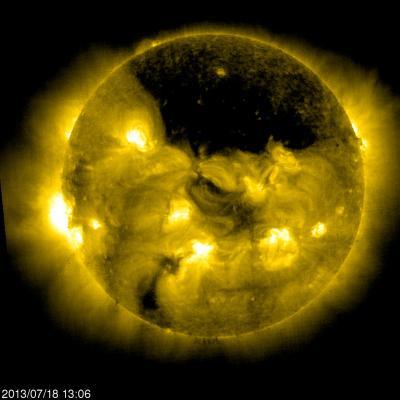
The European Space Agency/NASA Solar and Heliospheric Observatory, or SOHO, captured this image of a gigantic coronal hole hovering over the sun's north pole on July 18, 2013, at 9:06 a.m. EDT. Coronal holes are dark, low density regions of the sun's outermost atmosphere, the corona. They contain little solar material, have lower temperatures, and therefore, appear much darker than their surroundings.
Coronal holes are a typical feature on the sun, though they appear at different places and with more frequency at different times of the sun's activity cycle. The activity cycle is currently ramping up toward what is known as solar maximum, currently predicted for late 2013. During this portion of the cycle, the number of coronal holes decreases. During solar max, the magnetic fields on the sun reverse and new coronal holes appear near the poles with the opposite magnetic alignment. The coronal holes then increase in size and number, extending further from the poles as the sun moves toward solar minimum again. At such times, coronal holes have appeared that are even larger than this one.
The European Space Agency/NASA Solar and Heliospheric Observatory, or SOHO, captured this image of a gigantic coronal hole hovering over the sun's north pole on July 18, 2013, at 9:06 a.m. EDT.
(Photo Credit: ESA&NASA/SOHO)
The holes are important to our understanding of space weather, as they are the source of a high-speed wind of solar particles that streams off the sun some three times faster than the slower wind elsewhere. While it's unclear what causes coronal holes, they correlate to areas on the sun where magnetic fields soar up and away, failing to loop back down to the surface, as they do elsewhere.
Source: NASA/Goddard Space Flight Center
Gigantic coronal hole spotted over Sun's north pole


 Washington: European Space Agency/ NASA’s Solar and Heliospheric Observatory, or SOHO, captured images of a gigantic coronal hole hovering over the Sun's north pole on July 18.
Coronal holes are dark, low density regions of the sun's outermost atmosphere, the corona.
Coronal holes are a typical feature on the sun, though they appear at different places and with more frequency at different times of the sun's activity cycle.
The activity cycle is currently ramping up toward what is known as solar maximum, currently predicted for late 2013.
During this portion of the cycle, the number of coronal holes decreases.
During solar max, the magnetic fields on the sun reverse and new coronal holes appear near the poles with the opposite magnetic alignment.
The coronal holes then increase in size and number, extending further from the poles as the sun moves toward solar minimum again.
At such times, coronal holes have appeared that are even larger than this one.
The holes are important to our understanding of space weather, as they are the source of a high-speed wind of solar particles that streams off the sun some three times faster than the slower wind elsewhere.
ANI
Huge Solar Eruption To Pass Earth This Weekend
During a solar maximum, a normal period in the eleven year cycle of the sun, large numbers of sunspots appear and the sun’s irradiance output grows by about 0.1 percent affecting regional weather patterns. While this solar maximum won’t occur until the end of the year, the sun is reminding earth dwellers that’s it’s out there and can get a little angry on occasion.

Tuesday of this week was one such occasion where the sun erupted a massive coronal mass ejection, or CME, sending billions of tons of particles into the solar system and towards our planet and its inhabitants.
That’s right, the sun is angry and in addition to giving thousands of people skin cancer each year, its trying to blow up the earth. Wait, I’m being told that it’s actually quite benign and my sensationalistic journalism skills will not be needed over the weekend. Pity, I was hoping for a reason to get out of a family reunion on Saturday. While there is always plenty of booze, I generally come back with a black eye or at the very least a severely strained voice and what would be a massive hangover if I happened to believe in them.
Hangovers are like Santa Clause, once you stop believing in them they go away or at least I try to make that the case.
Solar Eruption Expected To Be Mild
The coming geomagnetic storm is expected to be on the mild side, compared to those we may see as the solar maximum approaches. The energy from the CME will for the most part be absorbed by the Earth’s protective magnetosphere. However, it is expected to disrupt radio-based communications and navigation equipment, including radio stations, walkie-talkies, and satellite-based GPS. The extent of this disruption is anybody’s guess, and the boffins who study these things vary widely in their predictions.
If you’re lucky enough to live in the earth’s more northerly or southerly regions, keep your skies and your camera at the ready. Geomagnetic storms cause aurora borealis and australis. If you’re one of the few people who actually understand your camera, Space Academy has a guide on the best camera settingsfor snapping what for some might be quite the show.
'Get ValueWalk's Daily Edition By Email and Never Miss Our Top Stories' - Click Here!
Jul 18, 2013
Steady leak in the Earth's plasmasphere found
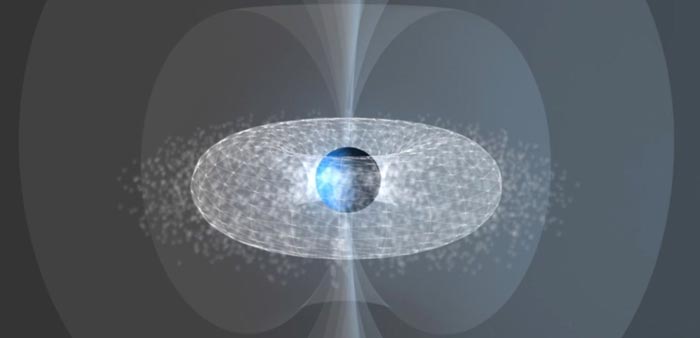
The presence of a "space wind" in the plasmasphere of the Earth has been detected for the first time, according to a physicist in France. The direct observation of this "plasmaspheric wind" – predicted theoretically more than 20 years ago – has been made by the European Space Agency's Cluster spacecraft. The phenomenon contributes to the loss of material from our atmosphere and may play a role in regulating the intensity of the Earth's radiation belts.
The plasmasphere is a region of the Earth's inner magnetosphere located above the ionosphere that is a torus of dense, ionized gas. Plasmaspheric wind was initially proposed by Joseph Lemaire and Robert Schunk in 1992. The phenomenon is caused by an imbalance in the three forces that act in the plasmasphere: the gravitational attraction of the Earth's mass, the centrifugal force caused by its rotation, and the pressure exerted by the plasma. The wind results in a steady movement of material out of this region into the upper magnetosphere – calculations showed it to be transporting around 1 kg of plasma every second, at speeds exceeding 5000 km per hour.
Blowing in the wind
As it slowly empties, the plasmasphere is filled by material from the underlying ionosphere. As such, the plasmaspheric wind plays an important role in atmospheric escape. Previously, transport of material out of the plasmasphere had only been observed in extreme conditions, when the Earth's magnetic field was disrupted by energetic particles coming from the Sun.
Measurements of this elusive space wind were obtained by the Cluster Ion Spectrometry experiment using the highly sensitive instrumentation aboard the four orbiting Cluster II spacecraft. "We now have experimental evidence that the plasmasphere is not in an equilibrium state, even during periods without geomagnetic storms," says physicist Iannis Dandouras, from the Centre National de la Recherche Scientifique (CNRS) and the University of Toulouse, France. He told physicsworld.comthat "The plasmasphere continuously blows out a weak but steady wind, supplying ionized material to the outer magnetosphere."
Steady flux
A special operating mode for the sensors enabled detection of ions at very low energies. By filtering out noise within the plasma data, Dandouras was able to reveal the steady flux of material away from the Earth. Analyses were made of the ion data across a variety of timeframes and different magnetospheric conditions to confirm that the wind is indeed a persistent phenomenon.
The plasma stored in this orbital region also plays a vital role in controlling the energy balance of the Earth's radiation belts. It is also responsible for causing delays in the propagation of global-positioning-system signals that pass through the plasmasphere.
"The plasma density in the region of space surrounding the Earth is of considerable interest," says Tim Yeoman, a physicist at the University of Leicester who was not involved in this study. He explains that the origin of this plasma was traditionally considered in terms of photoionized atmospheric particles escaping along the Earth's magnetic field, and the transport of ions across the boundary between the terrestrial and solar magnetic fields through magnetic reconnection. "Here, new observational evidence is provided of the transport of ions originating in the inner regions of the Earth's magnetic field across the magnetic field to the outer magnetosphere – a potentially important new process contributing to the balance between plasma sources and sinks within the Earth's magnetosphere," he says.
Other studies of magnetospheric phenomena are already in progress. "Following the recent launch of the Van Allen probes, we now have more satellites flying in the magnetosphere," Dandouras says, explaining that this will allow a greater range of simultaneous measurements across this region, which may be used for future analysis.
The work is published in Annales Geophysicae.

No comments:
Post a Comment