Solar storms and mass animal deaths - the connection
Posted by The Watcher on
Birds, fish, and sea life across the world have been dying in huge numbers over the last 2 years. Over 100,000 drum fish washed ashore in Arkansas; other sea life also are littering our shores; thousands of birds have fallen from the skies all over the world. Why? Arguably, increased solar activity coupled with a hole in the earth’s magnetosphere could be the cause. Current scientific knowledge informs us that birds and fish use the earth’s magnetic field during migrations.
The magnetosphere is the area around a planet in which that planet’s magnetic force is the dominant pressure. Earth is protected from the majority of solar radiation and storms by its magnetosphere, but not entirely.
In 2008 NASA detected a massive breach in the magnetosphere, allowing solar winds to penetrate and cause enormous geomagnetic storms. It is known that solar storms bombard our planet with highly charged particles that can affect the pineal gland in humans. The British Medical Journal has published findings that support the proposition that damage to the gland can cause humans to have a diminished sense of direction. Comparing the pineal gland in humans to that of the same gland in birds raised an interesting question. In humans the gland weighs 2.0 grams and equates to less than 1% of the brain’s total weight, whereas the pigeons pineal gland weighed 1.5 grams, 10% of the weight of their brain. While the pineal gland gives us our general sense of direction as iron rich blood flows through and drawn towards the magnetic north, the increased size in the pigeons likely indicate a greater sensitivity to the magnetosphere.
Migratory animals across the planet make use of magnetoaxis -- the ability to detect the magnetosphere. Recently it was discovered that birds can see the magnetic field through photoreceptors in their eyes. This allows them to orient themselves during migratory flights. A massive breach in the magnetosphere detected by NASA in 2008 permitted solar winds to generate enormous geomagnetic storms. Geomagnetic disturbances caused by the sun’s increased activity are likely impacting birds and fish.
Science Daily recently reported that creatures such as crabs, sharks, salmon, starfish and dolphins also possibly use the magnetic field for a second purpose beyond migration -- to detect prey. “Proceedings of the National Academy of Sciences journal found that tiny iron-rich cells called magnetite embedded in the nasal passages of rainbow trout were 100 times more powerful than previously thought, and essentially acted as tiny compass needles inside the animal’s sensory system.”
The recent death of more than 40,000 crabs, starfish, lobsters, and anemones in England highlights the biological effects of a disturbed magnetosphere. The fact that migratory creatures across the world rely on the magnetosphere as a map is indisputable. As we approach maximum solar wind activity, many more opportunities will be presented to study the effects that the changing magnetosphere may be having on our biology as well as that of other creatures on our planet.
Posted by The Watcher on
Birds, fish, and sea life across the world have been dying in huge numbers over the last 2 years. Over 100,000 drum fish washed ashore in Arkansas; other sea life also are littering our shores; thousands of birds have fallen from the skies all over the world. Why? Arguably, increased solar activity coupled with a hole in the earth’s magnetosphere could be the cause. Current scientific knowledge informs us that birds and fish use the earth’s magnetic field during migrations.
The magnetosphere is the area around a planet in which that planet’s magnetic force is the dominant pressure. Earth is protected from the majority of solar radiation and storms by its magnetosphere, but not entirely.
The magnetosphere is the area around a planet in which that planet’s magnetic force is the dominant pressure. Earth is protected from the majority of solar radiation and storms by its magnetosphere, but not entirely.
In 2008 NASA detected a massive breach in the magnetosphere, allowing solar winds to penetrate and cause enormous geomagnetic storms. It is known that solar storms bombard our planet with highly charged particles that can affect the pineal gland in humans. The British Medical Journal has published findings that support the proposition that damage to the gland can cause humans to have a diminished sense of direction. Comparing the pineal gland in humans to that of the same gland in birds raised an interesting question. In humans the gland weighs 2.0 grams and equates to less than 1% of the brain’s total weight, whereas the pigeons pineal gland weighed 1.5 grams, 10% of the weight of their brain. While the pineal gland gives us our general sense of direction as iron rich blood flows through and drawn towards the magnetic north, the increased size in the pigeons likely indicate a greater sensitivity to the magnetosphere.
Migratory animals across the planet make use of magnetoaxis -- the ability to detect the magnetosphere. Recently it was discovered that birds can see the magnetic field through photoreceptors in their eyes. This allows them to orient themselves during migratory flights. A massive breach in the magnetosphere detected by NASA in 2008 permitted solar winds to generate enormous geomagnetic storms. Geomagnetic disturbances caused by the sun’s increased activity are likely impacting birds and fish.
Science Daily recently reported that creatures such as crabs, sharks, salmon, starfish and dolphins also possibly use the magnetic field for a second purpose beyond migration -- to detect prey. “Proceedings of the National Academy of Sciences journal found that tiny iron-rich cells called magnetite embedded in the nasal passages of rainbow trout were 100 times more powerful than previously thought, and essentially acted as tiny compass needles inside the animal’s sensory system.”
The recent death of more than 40,000 crabs, starfish, lobsters, and anemones in England highlights the biological effects of a disturbed magnetosphere. The fact that migratory creatures across the world rely on the magnetosphere as a map is indisputable. As we approach maximum solar wind activity, many more opportunities will be presented to study the effects that the changing magnetosphere may be having on our biology as well as that of other creatures on our planet.
Migratory animals across the planet make use of magnetoaxis -- the ability to detect the magnetosphere. Recently it was discovered that birds can see the magnetic field through photoreceptors in their eyes. This allows them to orient themselves during migratory flights. A massive breach in the magnetosphere detected by NASA in 2008 permitted solar winds to generate enormous geomagnetic storms. Geomagnetic disturbances caused by the sun’s increased activity are likely impacting birds and fish.
Science Daily recently reported that creatures such as crabs, sharks, salmon, starfish and dolphins also possibly use the magnetic field for a second purpose beyond migration -- to detect prey. “Proceedings of the National Academy of Sciences journal found that tiny iron-rich cells called magnetite embedded in the nasal passages of rainbow trout were 100 times more powerful than previously thought, and essentially acted as tiny compass needles inside the animal’s sensory system.”
The recent death of more than 40,000 crabs, starfish, lobsters, and anemones in England highlights the biological effects of a disturbed magnetosphere. The fact that migratory creatures across the world rely on the magnetosphere as a map is indisputable. As we approach maximum solar wind activity, many more opportunities will be presented to study the effects that the changing magnetosphere may be having on our biology as well as that of other creatures on our planet.
What is electroreception and how do sharks use it?
Browse the article What is electroreception and how do sharks use it?
Browse the article What is electroreception and how do sharks use it?
What is electroreception, and how do sharks use it?
Sharks are literally wired for hunting. The finned predators of the high seas are equipped with a special sense called electroreception that allows them to home in on prey with deadly accuracy. Other members of the elasmobranch fish family -- rays and skates -- also share this trait, but sharks' electroreception abilities are the most finely tuned.
Electroreception simply means the ability to detect electrical currents. What does electricityhave to do with sharks' underwater habitat? Any muscular movement or twitches in living animals and fish create small electrical currents. At hospitals, electrocardiogram machinestrack the electricity resulting from our heart beating.
Open air does not conduct this electricity away from our bodies, but thankfully for sharks,salt water does. Salt in salt water contains sodium and chlorine ions. Ions are particles that have an electrical charge because they have lost or gained an electron. In water, these sodium and chlorine ions in salt separate and move freely, transporting electricity.
You can compare this to how batteries work. It's set up like an electrochemical cell that separates the negatively and positively charged ions. When connected by a wire, those opposite charges attract, meaning the positive and negative particles flow toward each other to pick up or drop off electrons to become stable again.
A similar thing happens in the interaction of living cells and salt water. Because fish cells have a charge different from the saltwater solution in which they swim, the contact creates a weak voltage in the same way as a battery. Sharks can sense the tiniest changes in this electrical current, down to one-billionth of a volt [source: Fields]. If two AA batteries were connected 1,000 miles (1,600 kilometers) apart, a shark could detect if one ran out [source: Viegas].
How can sharks do that? Read about the part of sharks' bodies that regulate this unique internal homing device on the next page.
The dots around this sand tiger shark's mouth are the ampullae de Lorenzini that facilitate electroreception.
Sharks are literally wired for hunting. The finned predators of the high seas are equipped with a special sense called electroreception that allows them to home in on prey with deadly accuracy. Other members of the elasmobranch fish family -- rays and skates -- also share this trait, but sharks' electroreception abilities are the most finely tuned.
Electroreception simply means the ability to detect electrical currents. What does electricityhave to do with sharks' underwater habitat? Any muscular movement or twitches in living animals and fish create small electrical currents. At hospitals, electrocardiogram machinestrack the electricity resulting from our heart beating.
Open air does not conduct this electricity away from our bodies, but thankfully for sharks,salt water does. Salt in salt water contains sodium and chlorine ions. Ions are particles that have an electrical charge because they have lost or gained an electron. In water, these sodium and chlorine ions in salt separate and move freely, transporting electricity.
You can compare this to how batteries work. It's set up like an electrochemical cell that separates the negatively and positively charged ions. When connected by a wire, those opposite charges attract, meaning the positive and negative particles flow toward each other to pick up or drop off electrons to become stable again.
A similar thing happens in the interaction of living cells and salt water. Because fish cells have a charge different from the saltwater solution in which they swim, the contact creates a weak voltage in the same way as a battery. Sharks can sense the tiniest changes in this electrical current, down to one-billionth of a volt [source: Fields]. If two AA batteries were connected 1,000 miles (1,600 kilometers) apart, a shark could detect if one ran out [source: Viegas].
How can sharks do that? Read about the part of sharks' bodies that regulate this unique internal homing device on the next page.

The dots around this sand tiger shark's mouth are the ampullae de Lorenzini that facilitate electroreception.
Electroreception for Hunting and Navigating
The source of sharks' electroreception lies around their snouts and lower jaws. If you look closely at a shark's face, you'll see tiny dots around its mouth that look like large blackheads. These vary in number depending on each species' hunting activity. Active sharks will have 1,500 or more, while the more sedentary ones have a few hundred [source: Parker].
The dots are open pores collectively called ampullae de Lorenzini. Filled with an electrically conductive jelly, the bottoms of the ampullae are lined with hairlike cells calledcilia. Electrical currents travel through the jelly to the cilia. In humans, cilia inside of our earsalert our brains to noise when moved by sound waves. In sharks, the cilia respond to changes in nearby electrical currents transported by the jelly. The cilia trigger the release of neurotransmitters in sharks' brains, which tells them something alive looms close by.
The ampullae de Lorenzini compose part of sharks' lateral line. The lateral line is a sensory organ in many fish and amphibians that stretches down their sides from gills to tail. The long, hollow tube opens out into the skin at perforated scales. This system allows sharks to sense water displacement, pressure and direction.
The lateral line and electroreception, along with sharks' other senses combine to make them incredibly keen hunters. Since two-thirds of a shark's brain is devoted to smell, its olfactory sense can get the shark hot on the trail of its next meal even in dark waters [source: Parker]. It's only when the shark gets about 3 feet (1 meter) away from its target that electroreception kicks in to orient its jaws for an accurate, final attack [source: PBS]. For that last few feet of the attack, great white sharks actually roll their eyes back into their heads for protection and let electroreception take over navigation [source: Dingerkus].
In experiments testing sharks' electroreception skills, scientists have confirmed that the fish will indeed make last-minute feeding decisions based on electrical impulses. For example, when given the option between dead fish and an electrically charged rod, a shark will initially head for the fish, then alter its course toward the metal rod at the last minute [source: Fields]. Through this type of research, scientists are hoping to develop a shark deterrent that tricks its electroreception sense.
The power of electroreception also explains why sharks will continue attacking human victims even while being rescued by another person. Instead of going for the fresh meat of the rescuer, sharks will be repeatedly drawn to their previous victims because of the salt released from blood in the water [source: Viegas]. The higher salt concentration increases the intensity of the electrical field around the victim.
Since sharks can track electrical changes so well, scientists also are investigating whether electroreception plays a role in their navigation skills. Some theorize that the Earth's magnetic fields may interact with salt water to form electrical currents that sharks follow during migration [source: Parker].
Want to learn more about sharks? Visit the links on the next page.
In a nutshell: The sun has and will again produce a solar storm the likes of which isn't seen for thousands of years. When this storm, or shall I say typhoon, occurs, it totally compresses the Earth's magnetosphere to the point where the lines of conductance actually touch the surface of the planet. This has three main effects, the first is that all metal on the planet will start to induct a current, with large metal pieces or long wires inducting significant voltages. The second effect is that the earths core, being most likely an iron/silicon alloy will induct enormous amounts of electrical current from the disruption of the magnetosphere though the blasting solar wind. This extra induction will transfer into heat, which will cause the core to spin more rapidly and to perturb the mantle with shockwaves and turbulence. Additionally, the heat will cause expansion, especially at the poles. The third effects comes from the combination of the first two, and that is that the crust will separate from the mantle and while floating on a newly created 'lubrication layer', will allow the global mass imbalance that currently exists to try to rectify itself. Of course this will be catastrophic for all living things on the planet.
For a full paper on the hypothesis, follow the Solar Typhoon Hypothesis link.
I will maintain this site as a dialog between myself and whoever is kind enough to take the time and see if I'm "yet-another-crackpot" or on to something.
The source of sharks' electroreception lies around their snouts and lower jaws. If you look closely at a shark's face, you'll see tiny dots around its mouth that look like large blackheads. These vary in number depending on each species' hunting activity. Active sharks will have 1,500 or more, while the more sedentary ones have a few hundred [source: Parker].
The dots are open pores collectively called ampullae de Lorenzini. Filled with an electrically conductive jelly, the bottoms of the ampullae are lined with hairlike cells calledcilia. Electrical currents travel through the jelly to the cilia. In humans, cilia inside of our earsalert our brains to noise when moved by sound waves. In sharks, the cilia respond to changes in nearby electrical currents transported by the jelly. The cilia trigger the release of neurotransmitters in sharks' brains, which tells them something alive looms close by.
The ampullae de Lorenzini compose part of sharks' lateral line. The lateral line is a sensory organ in many fish and amphibians that stretches down their sides from gills to tail. The long, hollow tube opens out into the skin at perforated scales. This system allows sharks to sense water displacement, pressure and direction.
The lateral line and electroreception, along with sharks' other senses combine to make them incredibly keen hunters. Since two-thirds of a shark's brain is devoted to smell, its olfactory sense can get the shark hot on the trail of its next meal even in dark waters [source: Parker]. It's only when the shark gets about 3 feet (1 meter) away from its target that electroreception kicks in to orient its jaws for an accurate, final attack [source: PBS]. For that last few feet of the attack, great white sharks actually roll their eyes back into their heads for protection and let electroreception take over navigation [source: Dingerkus].
In experiments testing sharks' electroreception skills, scientists have confirmed that the fish will indeed make last-minute feeding decisions based on electrical impulses. For example, when given the option between dead fish and an electrically charged rod, a shark will initially head for the fish, then alter its course toward the metal rod at the last minute [source: Fields]. Through this type of research, scientists are hoping to develop a shark deterrent that tricks its electroreception sense.
The power of electroreception also explains why sharks will continue attacking human victims even while being rescued by another person. Instead of going for the fresh meat of the rescuer, sharks will be repeatedly drawn to their previous victims because of the salt released from blood in the water [source: Viegas]. The higher salt concentration increases the intensity of the electrical field around the victim.
Since sharks can track electrical changes so well, scientists also are investigating whether electroreception plays a role in their navigation skills. Some theorize that the Earth's magnetic fields may interact with salt water to form electrical currents that sharks follow during migration [source: Parker].
Want to learn more about sharks? Visit the links on the next page.
In a nutshell: The sun has and will again produce a solar storm the likes of which isn't seen for thousands of years. When this storm, or shall I say typhoon, occurs, it totally compresses the Earth's magnetosphere to the point where the lines of conductance actually touch the surface of the planet. This has three main effects, the first is that all metal on the planet will start to induct a current, with large metal pieces or long wires inducting significant voltages. The second effect is that the earths core, being most likely an iron/silicon alloy will induct enormous amounts of electrical current from the disruption of the magnetosphere though the blasting solar wind. This extra induction will transfer into heat, which will cause the core to spin more rapidly and to perturb the mantle with shockwaves and turbulence. Additionally, the heat will cause expansion, especially at the poles. The third effects comes from the combination of the first two, and that is that the crust will separate from the mantle and while floating on a newly created 'lubrication layer', will allow the global mass imbalance that currently exists to try to rectify itself. Of course this will be catastrophic for all living things on the planet.
For a full paper on the hypothesis, follow the Solar Typhoon Hypothesis link.
I will maintain this site as a dialog between myself and whoever is kind enough to take the time and see if I'm "yet-another-crackpot" or on to something.
Magnetic-Shield Cracks Found; Big Solar Storms Expected
| Victoria Jaggard in San Francisco National Geographic News |
| December 17, 2008 |
| An unexpected, thick layer of solar particles inside Earth's magnetic field suggests there are huge breaches in our planet's solar defenses, scientists said. These breaches indicate that during the next period of high solar activity, due to start in 2012, Earth will experience some of the worst solar storms seen in decades. Solar winds—charged particles from the sun—help create auroras, the brightly colored lights that sometimes appear above the Earth's poles. But the winds also trigger storms that can interfere with satellites' power sources, endanger spacewalkers, and even knock out power grids on Earth. "The sequence we're expecting … is just right to put particles in and energize them to create the biggest geomagnetic storms, the brightest auroras, the biggest disturbances in Earth's radiation belts," said David Sibeck, a space-weather expert at NASA's Goddard Space Flight Center in Maryland. "So if all of this is true, it should be that we're in for a tough time in the next 11 years." (Related: "Sun's Power Hits New Low, May Endanger Earth?" [September 24, 2008].) Into the Breach Data from NASA's THEMIS satellite showed that a 4,000-mile-thick (6,437-kilometer-thick) layer of solar particles has gathered and is rapidly growing within the outermost part of the magnetosphere, a protective bubble created by Earth's magnetic field. Normally the magnetosphere blocks most of the solar wind, flowing outward from the sun at about a million miles (1.6 million kilometers) an hour. "The solar wind is constantly changing, and the Earth's magnetic field is buffeted like a wind sock in gale-force winds, fluttering back and forth in response to the solar wind," Sibeck said this week during a meeting of the American Geophysical Union in San Francisco. Earth's magnetic field lines align themselves in different directions over various regions of the planet. Near Earth's Equator, where solar winds press against the magnetosphere, the field lines point north. Solar winds also carry magnetic field lines toward Earth, and those solar field lines point in different directions during the sun's 11-year cycle of activity. Conventional thinking had suggested that north-pointing field lines would act like reinforcements to Earth's northward field, causing the planet to "raise shields" against solar winds. The idea is based, in part, on the fact that auroras are brighter and space-weather hazards increase when solar winds carry southward-pointing field lines, Sibeck said. "So it's reasonable to think that during periods when the sun's magnetic field lines point south, that's when the most particles get into Earth's magnetosphere." THEMIS, however, showed that the opposite is true. The satellite system "found the solar particle layer is much thicker when the two fields are pointing in the same direction," said Marit Øieroset, a THEMIS scientist based at the University of California, Berkeley, who first saw the effect. In fact, 20 times more particles get through Earth's magnetic shield when the field lines are aligned than when they are opposed, she said. Model Behavior To find the mechanism behind this discovery, Oieroset and Sibeck turned to computer models that could simulate the conditions observed by THEMIS. The models showed that the likely driver is north-facing field lines connecting with Earth's magnetosphere, said Jimmy Raeder, a physicist at the University of New Hampshire in Durham who helped build the simulations. As a field line approaches, it latches onto the poles and wraps around the planet like an octopus using a tentacle to snare its prey, he said. The latching, known as magnetic reconnection, tears huge cracks in the magnetosphere and allows solar plasma to leak in. "We have other observations from other satellites that this reconnection process happens over the poles at times, but we had never appreciated what it actually does," Raeder said. A thicker layer of solar particles, however, isn't enough by itself to create geomagnetic troubles for Earth. Right now the planet is enjoying a period of low activity called solar minimum. But particles have been building up inside the magnetosphere as the solar wind carries northward-facing field lines to Earth. During the next solar cycle, the winds are expected to carry southward-facing field lines, which connect with the magnetosphere in such a way that they provide extra charge to any plasma inside the shield. "You can sort of compare [the situation] to a gas stove," Raeder said. "If you turn on the gas and you light it right away, nothing will happen—the gas stove will go on and there will be a flame. "But if you turn on a gas stove and you don't do anything for a while and then you throw in a match, what will happen? It will say, Boom!" |
Officials Meet in Washington to Discuss Solar Storms, Great and Small06.04.13 Many technologies key to modern society are vulnerable to solar storms. Learn more from the National Space Weather Program.Image courtesy NSWP› Larger imageWhen government officials and scientists get together to talk about space weather, the discussion usually centers on big events.
The Carrington superflare of 1859 set fire to telegraph stations in North America and Europe and sparked Northern Lights as far south as Cuba and Tahiti.
The Quebec blackout of 1989 cut power and heat to millions of people in Canada and caused more than 200 electrical anomalies across grids in the United States.
The Halloween storms of 2003 temporarily disabled instruments on dozens of Earth-orbiting satellites, with some experiencing permanent damage.
This week, policy makers and researchers are getting together in Washington to talk about space weather--but the discussion is a little different.
On June 4, the National Space Weather Program Council convenes the fifth annual Space Weather Enterprise Forum. The purpose of this year's meeting is not to talk about big events that happen rarely, but rather to explore lesser storms that happen often. The theme for the meeting is "SpaceWeather Impacts: They Happen All the Time!"
The forum opens on June 4 with a keynote address from NASA Administrator Charlie Bolden, followed by expert presentations from NOAA, NASA, the U.S. Geological Survey, the Air Force, the National Science Foundation, airlines, electric utilities and other space weather stakeholders. Congressmen, executive-branch undersecretaries and other policy makers will be in attendance, deciding what to do next.
"We are pleased to present a wide-ranging and informative slate of speakers to address this year's theme," said Samuel P. Williamson, the federal coordinator for meteorology and chairman of the National Space Weather Program Council. "Attendees include national and international leaders and stakeholders from across government, industry and academia."
The theme of this year's SWEF recognizes that space weather is ever-present. The gaps between big events are not empty times of quiet. They are filled with lesser storms that can pose a threat to our increasingly high-tech society.
Air travel is a good example. At the meeting, Thomas Fahley and Gregg Scott of Delta Airlines will detail how solar flares and radiation storms caused multiple flights to be redirected away from the poles during 2012. To avoid communications blackouts and high-energy radiation, which are concentrated around the poles during solar storms, more than 16 transcontinental flights were detoured to more southerly latitudes. On a per-flight basis, the detours consumed as much as 9,950 extra pounds of fuel and added as much as $4,507 to the price tag of each flight. Delays and missed connections multiplied costs even more.
And that was just Delta. Other major airlines around the world have similar stories to tell.
Space weather affected the airlines in 2012 despite the fact that solar activity was relatively low. There were only a handful of X-class solar flares during the 12-month period. And while magnetometers counted more than two dozen geomagnetic storms in 2012, the vast majority were minor. Earth's magnetic field did not experience extreme storming even once.
However, the statistics of muted solar activity conceal an underlying potency. Lika Guhathakurta, the head of NASA's Living with a Star Program at NASA Headquarters, put it into perspective:
"Who needs an X-flare?" she said. "Small flares are powerful, too. They explode with as much energy as a billion atomic bombs dozens to hundreds of times every year. We feel their effects even when they don't make the news." Guhathakurta pointed out that our society relies more than ever on high-tech devices such as GPS, telecommunications satellites and smart power grids. "This makes us increasingly vulnerable to solar storms, great and small."
The sun is currently near the peak of Solar Cycle 24, but so far the strongest storms have missed Earth.
In July 2012, for instance, one of the fastest coronal mass ejections, or CMEs, of the Space Age blasted away from the sun's western limb traveling 3,500 km per second (about 2,175 miles per second). The resulting radiation storm was the most intense such event since 1976. Earth, however, was not in the line of fire. In fact, the only reason we know about it is that NASA's STEREO-A spacecraft was located over the blast site and measured the full brunt of the storm.
In May 2013, after a quiet spell of many months, a sunspot on the sun's eastern limb unleashed four X-class solar flares in quick succession. Again, the fusillade was not Earth-directed, and the bulk of the resulting CMEs missed our planet.
During Solar Cycle 24 Earth-directed activity has been dominated not by X-flares, but rather by a steady drizzle of weak (C-class) to medium-sized (M-class) eruptions. These are the kind of everyday events that speakers at SWEF will address.

NASA's Biggest Day: IRIS Blastoff in 24-Hours to Study the Massive Coronal Hole on the Sun
Jun 26, 2013
Space engineers at Vandenberg Air Force Base in California couple the Pegasus XL rocket with the Interface Region Imaging Spectrograph, or IRIS, solar observatory to the Orbital Sciences L-1011 carrier aircraft.
NASA will launch its IRIS mission on Thursday, June 27 at 10:27 p.m. EDT. Live NASA Television launch coverage begins at 9 p.m.
On June 18, 2013, NASA had discovered a giant hole in the Sun, which is heading our way.
Like Us on Facebook
NASA's Solar Dynamics Observatory had captured a picture of the sun, showing a huge coronal hole, which spread out over almost the entire upper left quadrant of the sun. NASA has described the giant gaping coronal gap as "extensive", "rotating our way" and bigger than anything they have seen in over a year.
This coronal hole is at least 400,000 miles across, which is more than 50 Earths side by side.
NASA's Skylab first spotted coronal holes in the early 1970s.
According to NASA, their size and number varies in concert with the sun's solar cycle, which reaches a maximum of activity approximately every 11 years. Late 2013 or early 2014, as the sun will head toward the maximum, the coronal holes move closer and closer to the sun's poles.
NASA will study the mysteries of the sun, yet many things to unveil.
IRIS will open doors for new discoveries. Using spectrometry and imaging, IRIS will trace the flow of energy and plasma through the chromospheres and transition region into the sun's corona.
NASA said:
"The IRIS mission will observe how solar material moves, gathers energy and heats up as it travels through a largely unexplored region of the solar atmosphere. The interface region, located between the sun's visible surface and upper atmosphere, is where most of the sun's ultraviolet emission is generated. These emissions impact the near-Earth space environment and Earth's climate."

Page Last Updated: June 20, 2013 Page Editor: Jim Wilson NASA Official: Brian Dunbar
NASA’s Solar Dynamics Observatory captured this picture of the sun on June 18, 2013, showing a huge coronal hole – seen here in dark blue -- spread out over almost the entire upper left quadrant of the sun. A coronal hole is an area of the sun’s atmosphere, the corona, where the magnetic field opens up and the material flows quickly out. This results in a cooler and less dense atmosphere than the surrounding areas. This coronal hole is at least 400,000 miles across, which is more than 50 Earths side by side. Coronal holes spew out fast solar wind, probably traveling at about 400-500 miles per second. This is roughly twice the speed of the normal solar wind, the solar material that is constantly streaming off the sun in every direction to fill the solar system.
Coronal holes were first spotted by NASA’s Skylab in the early 1970s. Scientists now know that their size and number varies in concert with the sun’s solar cycle, which reaches a maximum of activity approximately every 11 years. Every time the sun heads toward that maximum, currently expected for late 2013 or early 2014, the coronal holes move closer and closer to the sun’s poles.
This image of the sun from June 18, 2013, shows a coronal hole – that is, an area of cooler, less dense material in the sun’s atmosphere, the corona -- in the upper left side, represented in blue. In this image from NASA’s Solar Dynamics Observatory, the blue color represents light in the 171 Angstrom wavelength, which shows the coolest material present in the image. Two other wavelengths of light are also shown in the picture: 211 Angstroms, in red, and 193 Angstroms in brown. Credit: NASA/SDO
More information about SWEF may be found at http://www.nswp.gov/swef/swef_2013.html.
Tony Phillips
Heliophysics News Team
Watch NASA’s stunning launch of its IRIS satellite from a Lockheed L-1011
NASA launches IRIS.
By Staff, The Space Reporter
Friday, June 28, 2013

How does NASA launch a spacecraft designed to study the sun? By shooting it off from a Lockheed L-1011, of course.
The U.S. space agency on Friday released video footage of the launching of a new satellite designed to study Earth’s nearest star. The satellite, launched late Thursday, will provide scientists with a better understanding of the sun’s chemistry and how space weather events evolve.
Relying on a Pegasus rocket, the satellite was launched into orbit after detaching from a modified Lockheed L-1011 from California’s Vandenberg Air Force Base. At 39,000, the plane dropped the rocket before the ignition system kicked it, sending it on a short trip to low-Earth orbit. Following its 13-second mission to space, the satellite unfurled its solar panels, the last step before NASA will begin sending mission control directives.
According to a statement released by NASA officials, the successful launch of the satellite left the team “thrilled.” It was not, however, a launch without some tense moments. NASA reportedly lost contact with the spacecraft when communications signals were temporarily lost. The issue forced NASA to rely on other orbiting satellites to track the spacecraft as it exited Earth’s atmosphere.
While the mission itself is fairly straightforward, the space agency noted that it will provide scientists with an unprecedented vehicle for studying the sun. The 7-foot-long satellite weighs in at 400 pounds and its primary mission will require it to focus on a small region of the sun. Unlike the NASA’s Solar Dynamics Observatory, which keeps an eye on the entire sun, the satellite will focus on the small region of the sun located between the surface and the corona. The unexplored region is where much of the solar winds ejected by the sun build up over time, making it ideal for better understanding how solar flares and coronal mass ejections form.
With Earth-based communication relying more heavily on satellites, studying the sun in order to better understand the physics behind solar storms could provide Earth with an advanced warning system. Some experts have estimated that a massive solar storm could wreck havoc on the economy, producing upwards of hundreds of billions of dollars in damage. A monster ejection of geomagnetic particles from the sun could destroy 300 of the 2,100 high-voltage transformers that represent the backbone of the U.S. electric grid, according to a recently published report by the National Academy of Sciences (NAS). The destruction of a few crucial high-voltage transformers could leave much of the continent in technological darkness, the report noted.
The launch comes as NASA has warned the sun is entering one of its most active phases of its 13-year cycle. Both NOAA and NASA have forecast 2013 as the peak of the sun’s solar cycle, meaning Earth can expect to find itself on the receiving end of stronger and more intense solar storms, including some storms that may disrupt communication technology.
It remains unclear exactly how long the mission will last. According to NASA, the $181 million IRIS mission is currently slated to last two years, but some have said the solar explorer could last far longer.
Correction: An earlier version of this article noted NASA’s IRIS was launched from a Boeing 747. It was launched from a Lockheed L-1011.
Have something to say? Let us know in the comments section or send an email to the author. You can share ideas for stories by contacting us here.
Giant, oil-belching sinkhole dooms more than 100 homes in Louisiana
By John Upton
It’s looking like a neighborhood in Assumption Parish, La., has been permanently wiped out by a sloppy salt-mining company.
A sinkhole in the area has grown to 15 acres since an old salt mine that was emptied to supply the local petrochemical industry with brine began collapsing in August. Hundreds of neighbors were long ago evacuated, and many of them are now accepting that they will never return to their homes.
The sinkhole isn’t just endangering homes, it is also burping out oil, natural gas, and debris, shaking the area so powerfully that seismic equipment is being used to monitor the site. And brine from the sinkhole is in danger of contaminating local waterways. This thing is so big it even has its own Facebook page.

“While not every resident chose to participate in the settlement process, Texas Brine has been committed to offering reasonable offers to those residents who decided they wanted to move from the area and voluntarily participated in the settlement process,” [Texas Brine spokesman Sonny] Cranch said.
But not everybody thinks the offers are reasonable.
“Me and my wife worked for the last 10 years to get where we are,” Jarred Breaux said at his home Tuesday afternoon. “Do you feel like starting over?”
He said Texas Brine’s offer just wasn’t enough for him to pick up his family and leave his home, but he would be interested in extended discussions and participating in mediation with Texas Brine.
“I know we’ve got a big decision (to make) pretty soon,” said Breaux, who doesn’t have an attorney but said he likely will look for one soon.
This is not the first such trouble triggered by a former brine mine, but it caught the attention of Louisiana lawmakers. From a report earlier this month in the New Orleans Times-Picayune:
Gov. Bobby Jindal [on] Friday signed a slew of bills tightening regulations for underground cavern operators and written in response to a debris-filled sinkhole in the swamps of Assumption Parish. …
“These laws will ensure that companies are acting in good faith and upholding public safety. It’s critical that we hold companies accountable when they put communities at risk and these new laws will help achieve that goal,” Jindal said in a statement.
John Upton is a science fan and green news boffin who tweets, posts articles to Facebook, and blogs about ecology. He welcomes reader questions, tips, and incoherent rants: johnupton@gmail.com.
The Biggest Threat to the Economy Could Come From Outer SpaceBy Niraj Chokshi
Updated: June 12, 2013 | 4:16 p.m.
June 12, 2013 | 11:57 a.m.

Artist illustration of events on the sun changing the conditions in near-Earth space. (NASA)
Imagine waking up just after midnight to a sky so bright you swear it must be early morning. Imagine seeing the Northern Lights as far south as Cuba or Hawaii. Imagine that the same phenomena behind both has also generated electric fields in the ground strong enough to power small electronics. That's what happened in 1859, when the earth was struck by the most severe geomagnetic storm ever recorded.
Forget asset bubbles, recessions, or hurricanes—space weather could prove far more economically harmful. A severe geomagnetic storm—a sudden, violent eruption of gas and magnetic fields from the sun's surface—could prove particularly devastating. If the 1859 storm, known as the "Carrington event," were to recur today it could cause trillions of dollars in economic damage and take years to recover from, according to estimates.
The sun would sneeze and the economy could shatter.

That's a worst-case scenario, of course. NASA Administrator Charles Bolden was less dramatic at a space-weather conference hosted by the agency last week, though he did say that such events can be "just as punishing as a tornado" and are "a problem that crosses all borders." Magnetic storms can force Earth's magnetic fields to go temporarily haywire, overwhelming power grids.
The 1859 event didn't cause as much damage as it would today—electrical engineering was in its infancy—but it was globally felt. Here's how a 2008 space-weather report from the National Academy of Sciences described that year's storm:
From Aug. 28 through Sept. 4, auroral displays of extraordinary brilliance were observed throughout North and South America, Europe, Asia, and Australia, and were seen as far south as Hawaii, the Caribbean, and Central America in the Northern Hemisphere and in the Southern Hemisphere as far north as Santiago, Chile. Even after daybreak, when the aurora was no longer visible, its presence continued to be felt through the effect of the auroral currents. Magnetic observatories recorded disturbances in Earth's field so extreme that magnetometer traces were driven off scale, and telegraph networks around the world—the "Victorian Internet"—experienced major disruptions and outages.... In several locations, operators disconnected their systems from the batteries and sent messages using only the current induced by the aurora.
In other words, they literally ran the telegraphs from the electrical fields generated by the storm.
The 1859 event may be an extreme case, but there are more-recent examples of such space weather: in March 1989 a geomagnetic storm took down northeastern Canada's Hydro-Quebec power grid in just 90 seconds, leaving millions without power in the cold for up to nine hours. And a set of "Halloween" solar storms between October and November of 2003 sparked a National Academy of Sciences-led meeting on the societal and economic impact of space weather, which served as the basis of the report.
But it's not just scientists who are concerned about space weather. Lloyd's of London, the giant insurer, issued a report on the issue in 2010. In the foreword to the report, Lloyd's Tom Bolt warnedof a scientist-predicted spike between 2012 and 2015. "In terms of cycles, we are in late autumn and heading into winter," he wrote then. A severe space-weather event could prove devastating, according to the Lloyd's report.
In the worst case it can permanently damage transformers. In most cases, systems protecting power grids will detect problems and switch off before serious damage occurs. However, this may lead to a cascade effect in which more and more systems are switched off, leading to complete grid shutdown. In these situations it will take many hours to restore grid operation, causing disruption to operations and services, and potential loss of income.
The 1989 storm permanently damaged a $12 million New Jersey transformer. In 1921, a storm 10 times as bad struck. Today, that storm would permanently damage roughly 350 transformers, causing blackouts that would affect as many as 130 million people, according to a Metatech estimate.
An outside analysis conducted by Metatech for the Electromagnetic Pulse Commission and the Federal Emergency Management Agency found that the effects of a severe geomagnetic storm would not only be widespread, but long-lived. Such an event has "not only the potential for large-scale blackouts but, more troubling ... the potential for permanent damage that could lead to extraordinarily long restoration times," Metatech's John Kappenman told the NAS report's authors.
In a globalized world, all kinds of sectors would be impacted by a power failure. Fuel, food, water, sanitation, communications, medical/health, finance, and transportation would all feel cascading effects. Many businesses rely solely on satellite navigation for transportation on land and sea, and cell phones would be vulnerable to interference.
"Impacts would be felt on interdependent infrastructures, with, for example, potable water distribution affected within several hours; perishable foods and medications lost in about 12-24 hours; and immediate or eventual loss of heating/air conditioning, sewage disposal, phone service, transportation, fuel resupply, and so on," the NAS report found.
Hurricane Katrina caused roughly $80 billion to $125 billion in damage, according to the report. A future geomagnetic storm like the 1859 event could cost 10 to 20 times as much and take up to a decade to fully recover from, according to Metatech's estimates.
Get the latest news and analysis delivered to your inbox. Sign up for National Journal's morning alert, Wake-Up Call, and afternoon newsletter, The Edge. Subscribe here.
Solar cataclysm! Sun threatens Earth with possible geomagnetic storm
By Marshall Connolly, Catholic Online (NEWS CONSORTIUM)
May 14th, 2013
Catholic Online (www.catholic.org)
Astronomers monitoring the sun are reporting an astonishing flurry of activity. According to observations, the sun has let loose three major eruptions, known as solar flares, within a 24 hour period. The region of the sun responsible for the activity is moving and will point at Earth later this week.
LOS ANGELES, CA (Catholic Online) - Between Sunday and Monday, and within a 24 hour period, the sun has let lose three major flares, all in the X range. Solar flares are rated on a scale with X flares being among the largest possible. The latest flare erupted Monday night and registered as an X3.2, which is so far the most powerful solar flare of the year.
The flares are emanating from a dark region on the sun known popularly as a "sunspot." This sunspot region has been dubbed AR1748. Sunspots are dark because they are cooler than the surrounding region, however they remain amazingly hot. They are formed when magnetic field lines get twisted together. When those magnetic lines twist too much, they break, and often result in a solar flare.
Of the past three major flares, two have produced coronal mass ejections, which means some of the sun's material was flung far out into space, away from the sun at millions of miles per hour.
So far, these supercharged streams of solar material have missed the Earth because the active region on the sun (AR1748) isn't pointing in our direction. This will change within the next few days as the sun rotates.
By the end of this week, AR1748 will face Earth and any coronal mass ejections will probably impact the planet. Such impacts cause geomagnetic storms, which are responsible for displays of the northern and southern lights, also known as auroras.
While auroras are beautiful to watch, the solar events that cause them can be dangerous both in space and on Earth. Spacecraft and high-flying airliners can be exposed to increased radiation. Satellites and power grids on Earth are also susceptible to damage as electrical charges build up upon them. Satellites can be lost and power can be knocked out on Earth.
All this can be fixed however, and the only humans that are in real danger are those in orbit. Those flying are exposed to little more radiation than they receive during x-ray exams. Fortunately, the impact of a coronal mass ejection can be predicted and astronauts can take precautions while the rest of us on Earth are protected by the planet's magnetic field.
For most people, a geomagnetic storm simply means the rare treat of the northern or southern lights at middle latitudes.
The current spate of activity is normal for the sun as it reaches the climax of its 11-year cycle of activity. Every 11 years, the sun experiences increased activity as its magnetic field reverses. Then, the activity subsides and the sun remains quiet for the better part of the next decade.
What is most unusual about the current uptick in activity is that the sun has been abnormally quiet for the past two years, well at the lower range of average activity.
Scientists cannot predict if the sun will send a coronal mass ejection towards Earth within the next several days, but they do believe there will be more activity from the AR1748. If a major geomagnetic storm appears likely, we will provide additional coverage.
© 2013, Distributed by NEWS CONSORTIUM.
Space Storm Could Black Out US East Coast for Two Yearsby Karin Zeitvogel for RIA NovostiWashington DC (RIA Novosti) Jun 12, 2013
 File image. |
A sun storm on the scale of one that happened in 1859, which was recorded by British brewer and amateur astronomer Richard Carrington, would potentially have sweeping consequences on huge population clusters in the United States, experts at the Space Weather Enterprise Forum said.
"The United States population that is at risk of an extended power outage from a Carrington-level storm is between 20-40 million, with an outage duration of possibly 16 days to one to two years," said Kathryn Sullivan, the first woman to walk in space and now the acting administrator of the National Oceanic and Atmospheric Administration (NOAA), which hosted Tuesday's conference.
"The highest risk of storm-induced outages of these magnitudes in the United States is between Washington DC and New York City," she said, citing a report released last month by global insurance giant Lloyd's of London, which urged businesses to "think about their exposure to space weather."
"Space weather is not science fiction, it is an established fact," the Lloyds report said.
Space storms do have their hidden plusses: the Northern Lights, or aurora borealis, are a by-product of a storm in space. The super-storm of 1859 caused skies as far south as the Hawaiian Islands and Panama to erupt in red, green and purple auroras "so brilliant that newspapers could be read as easily as in daylight," NASA says on its website.
But the Carrington super-storm also sent a mammoth cloud of charged particles and detached magnetic loops - a "coronal mass ejection" - crashing into Earth's magnetic field, where it caused a geomagnetic storm that severely disrupted the telegraph system, which in the late 1800s was communications' equivalent of the Internet today.
"Spark discharges shocked telegraph operators and set the telegraph paper on fire. Even when telegraphers disconnected the batteries powering the lines, aurora-induced electric currents in the wires still allowed messages to be transmitted," NASA says.
An event on a similar scale today could cripple communications, said Sullivan.
"Our dependence on sophisticated electronics technology for almost everything we do today has introduced a new vulnerability into our societies," she said.
"We can't prevent space weather from happening but we can become more resilient to it," including by improving our capacity to accurately predict space weather events, taking steps to lessen the blow from space storms, and recovering better and faster when a space storm does hit.
Space weather is "one of six potential emergency scenarios in the upcoming shortlist of White House National Exercise Programs for 2013-14," Sullivan said, referring to training exercises that test the readiness of the United States to face various crisis scenarios.
The United States is also working with international partners to improve global readiness for the next big space storm, said NASA Administrator Charles Bolden, who next week will take part in the 56th session on the United Nations Committee on the Peaceful Uses of Outer Space, due to be held in Vienna, Austria.
The UN committee this year, for the first time, recognized space weather caused by solar activity as "a concern on par with close, approaching asteroids," Bolden said.
NASA is also collaborating with the European Space Agency on its Solar Orbiter mission, which aims to "brave the fierce heat" and study the sun from "closer than ever before," Bolden said, stressing that space weather, like terrestrial weather, "is a problem that crosses all borders."
Chance of Flares: Earth Directed Sun Spot “Harbors Energy for X-Class Eruptions”
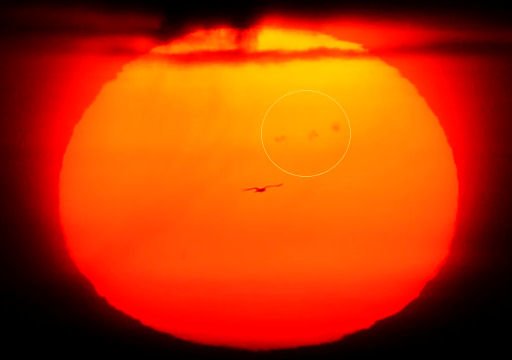
So far today, solar activity is low. However, that could be the calm before the storm. The magnetic field of big sunspot AR1654 has grown more complex. It is now classified as a ‘beta-gamma-delta’ magnetic field, which means it harbors energy for X-class eruptions.
If there is a flare today, the blast would be Earth-directed.
This sunrise shot, taken at dawn on Jan. 16th by Jan Koeman on the bank of the Westerschelde River in the Netherlands, shows how AR1654 (circled) is almost directly facing our planet
AR1654 Photo via Space Weather:
Though some ‘C’ and ‘M’ class flares have hit earth recently, none were strong enough to cause any serious, long-lasting damage, save some minor effects on satellites and radio stations.
X-Class flares, however, have the potential to wreak havoc across the globe. Similar to the earthquake Richter scale, going up from one class to the next means that the flare is at least 10 times as powerful as the level below it, so an ‘X-1 Class’ flare would be 10 times as powerful as the strongest ‘M’ class flare.
The effects of such a flare hitting earth could be disastrous, wiping out essential infrastructure components like power grids and utilities, satellite communications, cell phones, transportation systems, and the internet. It’s been theorized that a strong enough solar flare similar to the one that struck earth in 1859, known as the Carrington Event, could potentially wipe out modern day electronic systems and send human civilization back to the 19th century.
In 1989, it took only seconds for Hydro-Quebec, the company that supplies power to the Canadian region, to fail when an intense geo-magnetic storm struck earth andcaused a cascading breakdown in the electric grid. It is believed that the solar flare which caused the outage was rated at a class of X-15, and luckily only struck a small portion of the northern hemisphere.
In July of 2012 an X-1 flare narrowly missed earth.
Scientists have rated solar flares into different “divisions,” identified by a number following the letter class. In general, solar flare classes are rated from 1-9, but scientists have, as recently as 2003, measured flares that were literally off the charts:
Then come the X-class flares. Although X is the last letter, there are flares more than 10 times the power of an X1, so X-class flares can go higher than 9.
The most powerful flare measured with modern methods was in 2003, during the last solar maximum, and it was so powerful that it overloaded the sensors measuring it. The sensors cut out at X28.
The biggest X-class flares are, by far, the largest explosions in the solar system and are awesome to watch. Loops tens of times the size of Earth leap up off the Sun’s surface when the Sun’s magnetic fields cross over each other and reconnect. In the biggest events, this reconnection processcan produce as much energy as a billion hydrogen bombs.
Should one of these off the chart flares be directed at earth, we could be looking at an Armageddon-like event in its aftermath.
According to Frank Gaffney, president of the Center for Security Policy, if electronic systems in the United States were wiped out, the consequences would be lead to a complete breakdown in society. Though Gaffney bases his assessment on the threat of an electro-magnetic pulse weapon, a powerful enough solar flare could cause similar destruction:
“Within a year of that attack, nine out of 10 Americans would be dead, because we can’t support a population of the present size in urban centers and the like without electricity.”
How likely is it that such a powerful geo-magnetic storm could hit earth?
According to a recent research study published by Space Weather: The International Journal of Research and Applications, the odds are not in our favor:
By showing that the frequency of occurrence scales as an inverse power of the severity of the event, and assuming that this relationship holds at higher magnitudes, we are able to estimate the probability that an event larger than some criteria will occur within a certain interval of time in the future. For example, the probability of another Carrington event occurring within the next decade is ∼12%.
It’s solar roulette and eventually our number will be up.

No comments:
Post a Comment